Overview
AlcorNotifire is an AI-powered monitoring and notification platform designed to continuously monitor authorized online sources, analyze newly discovered content using Large Language Models (LLMs), and notify users when information matching their interests becomes available.
Unlike traditional keyword-based alert systems, AlcorNotifire combines scheduled content ingestion, AI-powered semantic analysis, event-driven processing, and multi-channel notifications to determine whether new information is genuinely relevant before notifying users.
The platform is built as a modular monolith, allowing clear separation of business capabilities while remaining simple to develop, deploy, and evolve. Each module owns its business logic and communicates through internal events, making the system highly maintainable and future-ready for service extraction if scaling requirements emerge.
Features
Modular Monolith Architecture
- Feature-Based Modules: Authentication, Monitoring, Sources, AI Analysis, Alerts, Notifications and Background Jobs
- Clear Module Boundaries: Independent business modules with well-defined responsibilities
- Internal Event Bus: Decoupled communication between modules using domain events
- Shared Infrastructure: Common configuration, logging, database access and utilities
AI-Powered Content Analysis
- Semantic Relevance Detection: Goes beyond simple keyword matching
- LLM Summarization: Generates concise summaries for detected content
- Content Classification: Categorizes monitored documents
- Configurable Prompt Templates: Easily customize AI behavior
Monitoring Engine
- Scheduled Monitoring: Cron-based polling of external providers
- Provider Architecture: Easily add new monitoring sources
- Content Normalization: Standardizes data from different providers
- Duplicate Detection: Prevents processing identical content multiple times
Notification System
- Multi-Channel Delivery
- Slack
- Discord
- Retry Mechanism
- Delivery History
- Channel Configuration
Background Processing
- BullMQ Queues
- Redis-backed Workers
- Automatic Retries
- Job Scheduling
- Asynchronous AI Processing
Modern Dashboard
- React + Vite
- Monitor Rule Management
- Alert History
- Notification Configuration
- Source Management
- System Status Dashboard
System Design
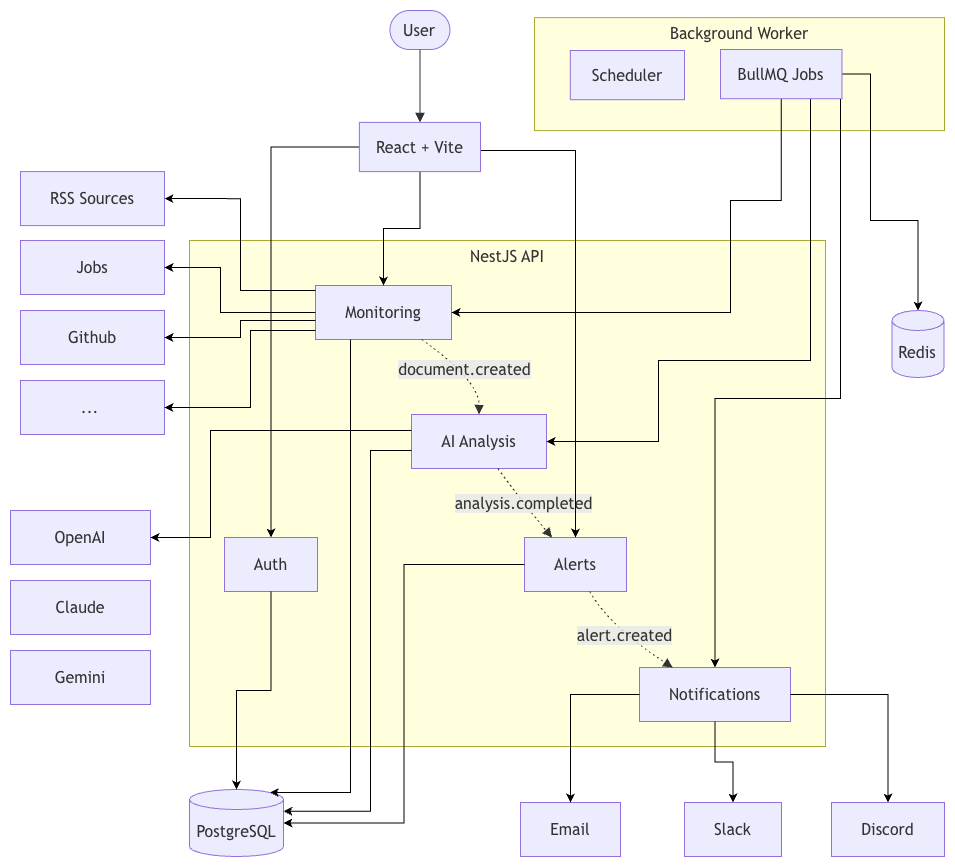
Core Components
-
Monitoring Engine — Schedules monitoring jobs, manages monitoring rules, and coordinates external source providers.
-
Source Providers — Fetch and normalize data from RSS feeds and other authorized APIs using a pluggable provider architecture.
-
AI Analysis Engine — Evaluates content relevance, generates summaries, classifies documents, and produces structured analysis results using LLMs.
-
Alert Engine — Creates alerts from AI analysis results and manages their lifecycle.
-
Notification Engine — Delivers alerts through multiple notification channels with retry handling and delivery tracking.
Architecture Layers
┌───────────────────────────────────────────────┐
│         React Dashboard (Vite)                │
├───────────────────────────────────────────────┤
│             NestJS REST API                   │
├───────────────────────────────────────────────┤
│ Authentication │ Monitoring │ Alerts │ Users  │
├───────────────────────────────────────────────┤
│ Sources │ AI Analysis │ Notifications │ Jobs  │
├───────────────────────────────────────────────┤
│ PostgreSQL │ Redis │ OpenAI │ External APIs   │
└───────────────────────────────────────────────┘
Event-Driven Processing Pipeline
Scheduler

      │

      ▼

Source Provider

      │

      ▼

Normalize Content

      │

      ▼

Store Document

      │

      ▼

AI Analysis

      │

      ▼

Create Alert

      │

      ▼

Notification Queue

      │

      ▼

Email / Slack / Discord
Module Architecture
| Module | Responsibility |
|---|---|
| Authentication | User authentication and authorization |
| Monitoring | Monitoring rules, scheduling and orchestration |
| Sources | External provider integrations |
| AI Analysis | LLM-powered relevance analysis and summarization |
| Alerts | Alert creation and lifecycle management |
| Notifications | Multi-channel notification delivery |
| Jobs | Background processing and queue management |
| Shared | Common utilities, configuration and logging |
Technology Stack
- Frontend: React 19, Vite, TanStack Query, Tailwind CSS, shadcn/ui
- Backend: NestJS, TypeScript
- Database: PostgreSQL, Prisma ORM
- Queue: BullMQ with Redis
- AI: OpenAI API
- Infrastructure: Docker, Docker Compose, AWS (ECS, RDS, ElastiCache, S3, CloudFront)
- Tooling: pnpm Workspaces, Vitest, ESLint, Prettier
- Architecture: Modular Monolith, Event-Driven Design, Provider Pattern
Design Philosophy
AlcorNotifire is built around the principle that relevance is more valuable than volume. Rather than forwarding every piece of matching content, the platform uses AI to understand context, evaluate significance, and notify users only when information is genuinely relevant.
The architecture emphasizes modularity without operational complexity. A modular monolith provides clear ownership boundaries, independent feature development, and maintainable code while avoiding the deployment and operational overhead of microservices.
Business capabilities communicate through internal events rather than direct dependencies, allowing each module to evolve independently. External systems—including AI providers, content sources, and notification channels—are abstracted behind provider interfaces, making the platform easily extensible without impacting the core domain.
Designed as a production-ready backend platform, AlcorNotifire demonstrates modern software architecture practices including event-driven processing, asynchronous job execution, AI integration, modular design, cloud-native deployment, and clean separation of concerns.